Posts

Showing posts with the label Sustainability

Together we can!

Image
More and more great actions and initiatives are on the rise! The following attracted our interest most. The Raw Foundation This foundation is a consumer-facing organisation that targets plastic from environmental life-cycle perspective and their aim is to reduce the amount of plastic (i.e. bottles) and promote sustainable re-use solutions. Just like us! They are championing tap water Just like us! What they do.  Next to raising awareness, making preventive education materials and setting up award schemes, they make plastic free festival guides for organizers and goers! Their biggest campaign.  They led the world's first expedition to explore the length of Africa from Cape Town to Cairo to shine a global spotlight on the scale and peril of plastic pollution, to raise awareness about the true extent of 'transboundery' plastic pollution and to inspire action worldwide. What they found. Over 17,000km bush camping they found plastic everywhere of which 18% were bottles. ...
Image
" By 2050, there will be more plastic in our oceans than fish". Estimates like these make me cringe, and make me wonder, why people are so reluctant to change their habits only a little. Why is it so difficult for many to give up plastic bags or bottles for the greater good? And how can people not see that giving up plastic will also benefit their own health? Thinking about this I often get very frustrated.  Luckily, there are many young and motivated people which know which consequences our current behaviour will pose for our ecosystems. This great video gives impressions on the current state of our oceans! It's time to become active and be part of positive change. Leave your mark here: Take the Parley AIR pledge - Avoid, Intercept and Redesign. You have great ideas and are eager to collaborate with those that share the passion of saving the oceans? Join the movement, become part of the Parley Team and make your mark for the oceans: https://a...

It takes 1/4 of a bottle of oil to produce a single water bottle.

Image
Some of single use water bottles' most damaging effects occur before they actually exist - while they are still being made. They require an enormous amount of resources to product, and their byproducts are harmful for mother earth. Plastic bottles are made from a petroleum product known as a polyethylene terephthalate (PET), and they require terrifying amounts of fossil fuels to both make and transport them, including oil.  The amount of oil that is required to make one plastic bottle is as much as 25% of a plastic bottle filled with it. The cost of this oil is 90% of the total cost of the production of a water bottle. To provide the world's supply of bottled water 17 million barrels with oil are required. With this amount of oil we can fuel 1.3 million cars for a year or provide 190,000 homes with power. By burning this amount of oil, 2.5 million tons of carbon dioxide will be emitted... How easy is it to contribute to a cleaner planet? Very easy. Just stop buying pla...
Image
"We will promote easy access to tap water on the streets of Europe to reduce demand for bottled water" - European Commission, May 29 2018 Breaking news: plastic bottels, Q-tips, straws, disposable cutlery, coffee cups, balloons, candy wrappers and other throwaway single use plastics that take 5 seconds to produce and 500 years to degrade need to banned, announce the EU this week. The EU is waging war against plastic waste as part of an urgent plan to clean up Europe's act and ensure that every piece of packaging on the continent is reusable or recyclable by 2030. Following China's decision to ban imports of foreign recyclable material, Brussels last Tuesday launched a plastics strategy designed to change minds in Europe, potentially tax damaging behaviour of manufacturers, and modernise plastic production and collection by investing €350m in research.  Most importantly, 9 out of 10 plastic bottles should be separated and collected in the form of deposit...

What happens if we reuse plastic bottles multiple times?

Image
Just re-using your plastic bottles from super markets might not do the trick. Even though I have a reusable bottle made of steel , I sometimes forget it at home. Since I am not a camel, going without water for a day seems pretty tough. Despite my ethical motivations, the thought and need for some water then often lures me to the next supermarket. Generally, I know how bad plastic bottles are, so I justify buying bottled water to myself, by thinking; 'It's not that bad, I'll just use it more than once'. What I know now, is that this doesn't really work. Studies have shown that the plastic used for plastic bottles actually segregates over time, leaving harmful chemicals and particles in the water you drink. That means that even the plastic bottle might be relatively safe and passes health standards for emitting chemicals, after some time and refills, this is not the case anymore. So if I reuse plastic bottles to make up for my tardiness, I actually provok...

Where does your water bottle end up?

Image
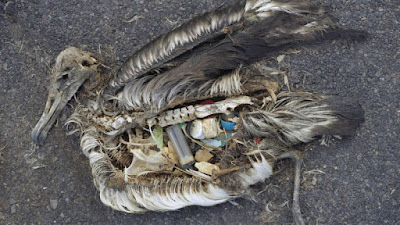
One of the most obvious impacts of plastic bottles is what happens after the water has been consumed Despite recycling infrastructure that exists in order to facilitate the recycling of these bottles, according to the Container Recycling Institute, 80% of plastic water bottles used become garbage that ends up in landfills . That means roughly for every 10 bottles we drink, only two end up in the recycle bin. Considering that approximately 60 million plastic water bottles are used every day in the US, we can assume that nearly 18,834,000,000 end up in the landfill of the US only each year The vast majority of what's found in the sea originates from the land - from sewage, storm drains, waterways, beach and coastal litter, as well as dumping, industrial activities and landfill sites. Compared to plastic in oceans, we are able to more directly manage landfills. On average each bottle takes 400 up to 700 years to decompose . This means the biggest risk of plastic water bottle...

How much are we spending on bottled water?

Image
Did you know that in the United States, people consume more bottled water than milk or beer? That's right, the average consumer drank over a hundred liters of bottled water a year despite the fact that drinking tap water is safe in over 90% of the USA households. The trend is not limited to just United States. People everywhere consume more and more bottled water. According to research, bottled water is 500-1000 times more expensive than tap water. The crazy thing is that almost half of the bottled water is derived from tap water. You are paying an insane amount of money and wasting time and energy in hauling bottled water to your house, but you get very little in return. Bottled water for the Western world is a scam that was created by big corporations such as Coca-Cola, PepsiCo and Quaker. Leaders in these companies are waging war against tap water because it cuts into their revenue.  Think before giving away your money for a bad cause like bottled water!

WHAT IS THE TRUE COST OF BOTTLED WATER?

Image
On this page you will find what the costs of bottled water are for the environment, social costs and what it does to YOU. The purpose of this blog is to make you think about your own water consumption and set some facts straight.  This is a student-led campaign and it will run until 13 June 2018. Please go ahead and have a look at our posts and learn why you should stop buying bottled water!