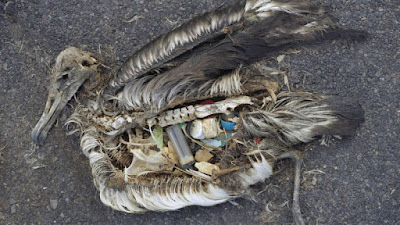
" By 2050, there will be more plastic in our oceans than fish". Estimates like these make me cringe, and make me wonder, why people are so reluctant to change their habits only a little. Why is it so difficult for many to give up plastic bags or bottles for the greater good? And how can people not see that giving up plastic will also benefit their own health? Thinking about this I often get very frustrated. Luckily, there are many young and motivated people which know which consequences our current behaviour will pose for our ecosystems. This great video gives impressions on the current state of our oceans! It's time to become active and be part of positive change. Leave your mark here: Take the Parley AIR pledge - Avoid, Intercept and Redesign. You have great ideas and are eager to collaborate with those that share the passion of saving the oceans? Join the movement, become part of the Parley Team and make your mark for the oceans: https://a...
Posts
Showing posts with the label plastic
- Get link
- X
- Other Apps
"We will promote easy access to tap water on the streets of Europe to reduce demand for bottled water" - European Commission, May 29 2018 Breaking news: plastic bottels, Q-tips, straws, disposable cutlery, coffee cups, balloons, candy wrappers and other throwaway single use plastics that take 5 seconds to produce and 500 years to degrade need to banned, announce the EU this week. The EU is waging war against plastic waste as part of an urgent plan to clean up Europe's act and ensure that every piece of packaging on the continent is reusable or recyclable by 2030. Following China's decision to ban imports of foreign recyclable material, Brussels last Tuesday launched a plastics strategy designed to change minds in Europe, potentially tax damaging behaviour of manufacturers, and modernise plastic production and collection by investing €350m in research. Most importantly, 9 out of 10 plastic bottles should be separated and collected in the form of deposit...
What happens if we reuse plastic bottles multiple times?
- Get link
- X
- Other Apps
Just re-using your plastic bottles from super markets might not do the trick. Even though I have a reusable bottle made of steel , I sometimes forget it at home. Since I am not a camel, going without water for a day seems pretty tough. Despite my ethical motivations, the thought and need for some water then often lures me to the next supermarket. Generally, I know how bad plastic bottles are, so I justify buying bottled water to myself, by thinking; 'It's not that bad, I'll just use it more than once'. What I know now, is that this doesn't really work. Studies have shown that the plastic used for plastic bottles actually segregates over time, leaving harmful chemicals and particles in the water you drink. That means that even the plastic bottle might be relatively safe and passes health standards for emitting chemicals, after some time and refills, this is not the case anymore. So if I reuse plastic bottles to make up for my tardiness, I actually provok...
Where does your water bottle end up?
- Get link
- X
- Other Apps
One of the most obvious impacts of plastic bottles is what happens after the water has been consumed Despite recycling infrastructure that exists in order to facilitate the recycling of these bottles, according to the Container Recycling Institute, 80% of plastic water bottles used become garbage that ends up in landfills . That means roughly for every 10 bottles we drink, only two end up in the recycle bin. Considering that approximately 60 million plastic water bottles are used every day in the US, we can assume that nearly 18,834,000,000 end up in the landfill of the US only each year The vast majority of what's found in the sea originates from the land - from sewage, storm drains, waterways, beach and coastal litter, as well as dumping, industrial activities and landfill sites. Compared to plastic in oceans, we are able to more directly manage landfills. On average each bottle takes 400 up to 700 years to decompose . This means the biggest risk of plastic water bottle...
What is BPA, PBDE or TBBPA, and what does this have to do with my “pure and clean” bottle of Evian?
- Get link
- X
- Other Apps
In our last post we explained how harmful plastics in bottled water impact our health . Today we will explain what exactly happens in our body if we are in too much contact with plastics. This is important to know, as the chemicals plastic needs to sustain can have a large effect on the human body. These harmful chemicals we talk of are BPA, PBDE or TBBPA. Shockingly, these chemicals have now also been found in us humans. And while they help to make plastic durable, they have a drastically altering effect on our endocrine system . The endocrine system is responsible for managing and transmitting hormones in our body. Seems quite relevant, right? To give an example of how these chemicals work we will take a closer look at BPA. The chemical BPA works similar to the hormone oestrogen . Oestrogen is the female sex hormone necessary to develop the female reproductive system. (Specialists call BPA a Xenoestrogen , because it is a synthetic product which merely imitates h...